
By: Jamal Loutfi , SUPERP
The integration between Testersuite Tosca didn't start on the drawing board, but out of sheer frustration
At a major network operator, testers automatically ran hundreds of test cases per day in Tosca, but had nowhere to share the results. Anyone who wanted to see the progress was sent a manually cobbled-together report full of screenshots via email.
At a major retailer, an initial market assessment for integrating Tosca and Testersuite resulted in Testersuite proposal that was very costly and could only be implemented for a single client. What SUPERP ultimately delivered cost a fraction of that and was operational elsewhere.
A need that grows along with testing maturity
The question regarding the integration between the test management platform Testersuite and Tricentis’s test automation solution Tosca has been a recurring topic among Testersuite customers for years. The larger an organization is, the higher (usually) its test maturity, and the sooner it makes the move to test automation.
Testersuite order to what you test and how often; once Tosca is added to the mix, you’ll want to see those automated test results alongside the manual ones. Without this integration, two separate realities emerge: automated test results in Tosca and manual ones in Testersuite, with no unified view of coverage and progress. With our first major client, that need became concrete enough to prompt us to do something about this lack of insight.
We explored several routes before the solution turned out to be right under our noses
The major retailer took the first step by approaching Tricentis itself, the makers of Tosca. The proposal that resulted was expensive and was intended for use by exactly one customer.
A second inquiry, directed at a former Tricentis employee, yielded a similar result. It turned out that SUPERP had already facilitated this integration for a major grid operator. From that point on, things moved quickly.
Why Customers Want More Than Just Individual Test Results
The bottom line is simple: customers want to manage the testing process based on a single, comprehensive view of test coverage and progress, rather than maintaining two separate sets of records.
This was a major concern for the network operator: people without access to Tosca couldn’t see the results of the nightly run, and that felt like a significant shortcoming. A solution had to be found quickly.
What it brings, even beyond the euros
The biggest savings come mainly from the time saved: no more manually creating reports, no more collecting screenshots for the morning email.
What weighs just as heavily on my mind is that the elimination of the repetitive, error-prone task of retyping results has a noticeable negative impact on the testers’ motivation.
Testersuite developed a feature that further enhances this benefit. It is now possible to share test reports with stakeholders with the click of a button, without them needing a Testersuite themselves.
A feature that makes it easier to widely distribute the test results, even independently of this Tosca integration.
How the coupling works technically
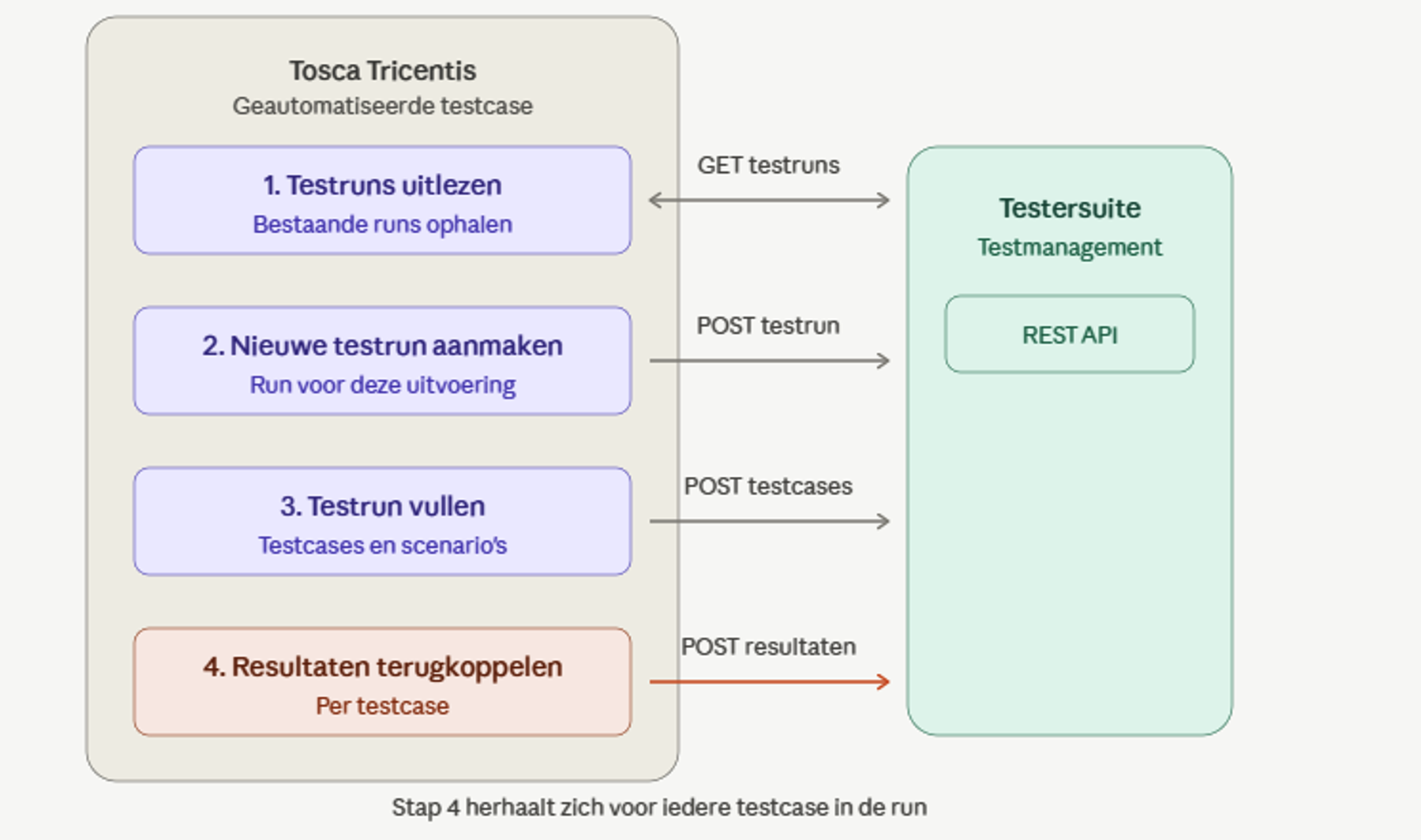
There are two options, depending on which technology a customer is already using. The first option sends the test results directly from Tosca to Testersuite is the most recently implemented option, including at the retailer that operates a single environment.
The second runs through a GitLab or GitHub pipeline—from launching test cases to writing back results—and is hosted by the network operator, who works with about forty decentralized Testersuite .
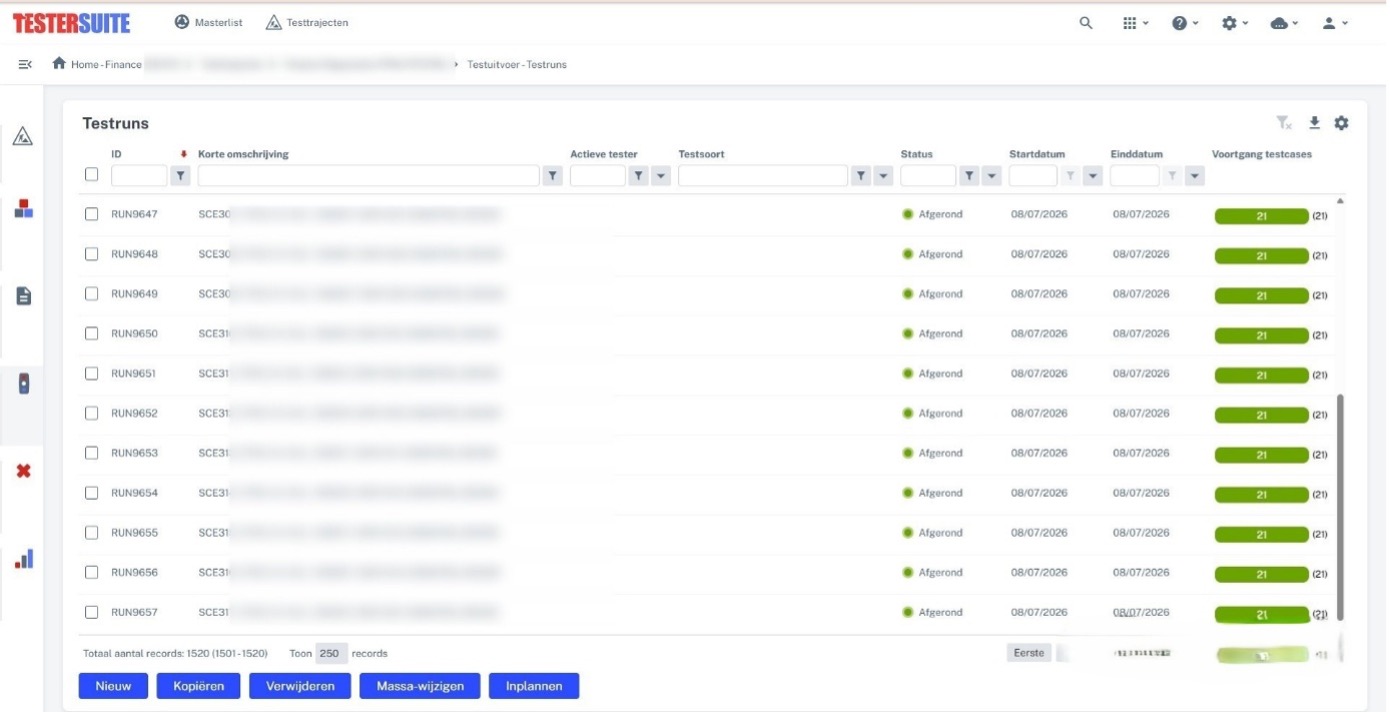
In both cases, the integration retrieves test scripts and test run information from Testersuite, Tosca prepares a test run, and each step in the test run is reported as either passed or failed—in one variant, in real time and continuously for each test case; in the other, only at the end of the entire run.
In terms of performance, the impact remains negligible: the connector issues a series of API calls that are processed in milliseconds, even during multiple parallel runs, because each run is assigned its own isolated call with a specific run ID.
The vulnerability inherent in any integration
There is one real concern: the integration relies on Testersuite(internal) APIs. If the underlying layer or architecture in Tosca changes, the integration will need to be reconfigured accordingly.
That’s a fairly common drawback of any integration—even with Testersuite own Tosca or Azure integrations, if one side changes without the other side adjusting accordingly, something will go wrong somewhere.
However, the core framework of Testersuite rarely Testersuite ; new functionality is almost always built alongside it, not on top of it.
Maintenance remains minimal
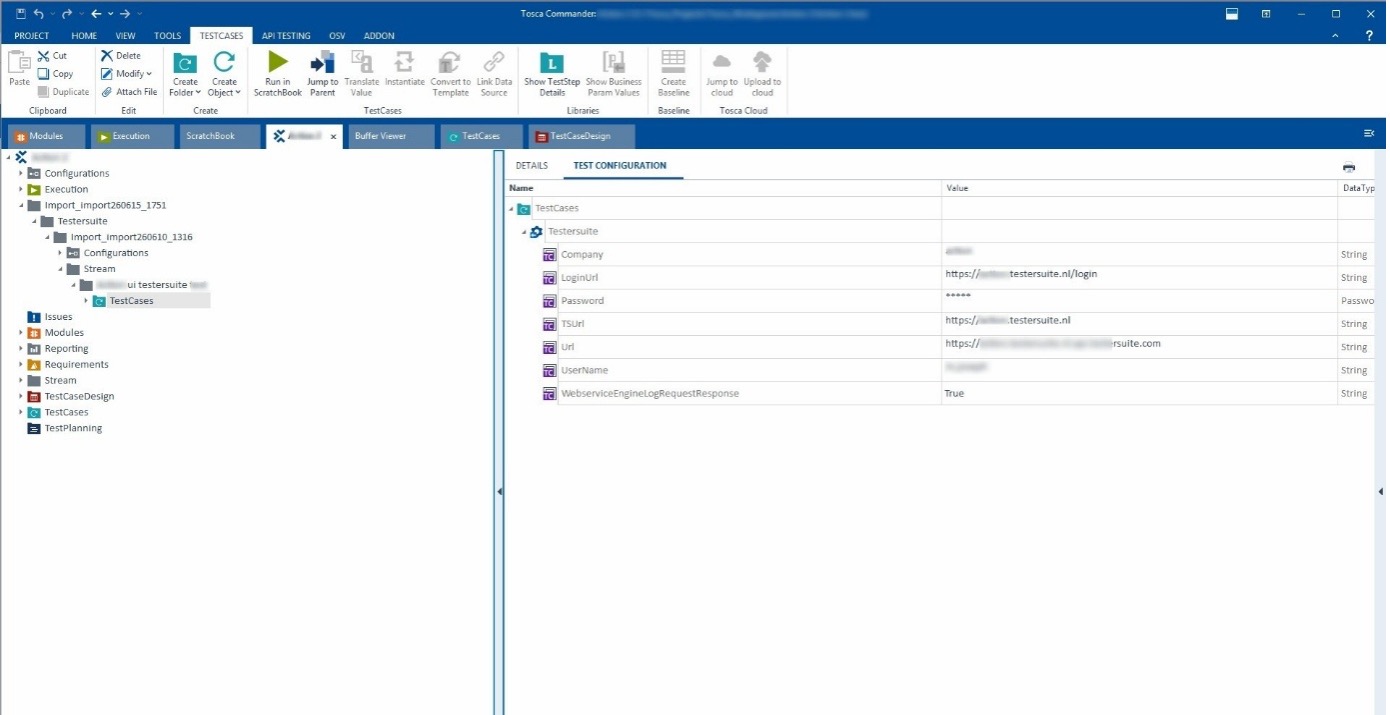
Once set up, the integration requires no further attention. In theory, a customer fills out five configuration fields, including login credentials that are masked within their own Tosca environment.
A new configuration is required only when setting up a new environment—a new workspace within Testersuite.
For the network operator, which has about forty decentralized Testersuite , this is a recurring concern; for the retailer, which has exactly one environment, there is simply no maintenance required after the initial setup.
No SLA, but direct communication channels
The connector is intentionally not marketed as a high-tech product with warranties and SLAs: SUPERP ensures that it is delivered in working order and provides support as needed.
Neither the grid operator nor the retailer received any reports after commissioning indicating that the connection was not working.
Interested customers can contact Testersuite SUPERP; communication between the two parties is close enough that it doesn't matter which one they contact.
Conclusion
- The Testersuite integration combines manual and automated test results into a single overview of coverage and progress.
- There are two technical options: real-time updates or via a GitLab/GitHub pipeline, depending on the customer's infrastructure.
- Maintenance is limited to configuring new environments; the core structure of the integration rarely changes.
- This integration also opens up opportunities for customers who do not yet have the Testersuite Tosca combination: Testersuite who want to start automating their tests and Tosca customers who are looking for a test management solution.
What started as a few isolated explorations has become an integration at SUPERP that is now in use by several customers.
Wondering if this works for your Testersuite or Tosca environment too? Contact SUPERP or schedule a consultation with Testersuite. 👇🏼
{{special-component}}


